
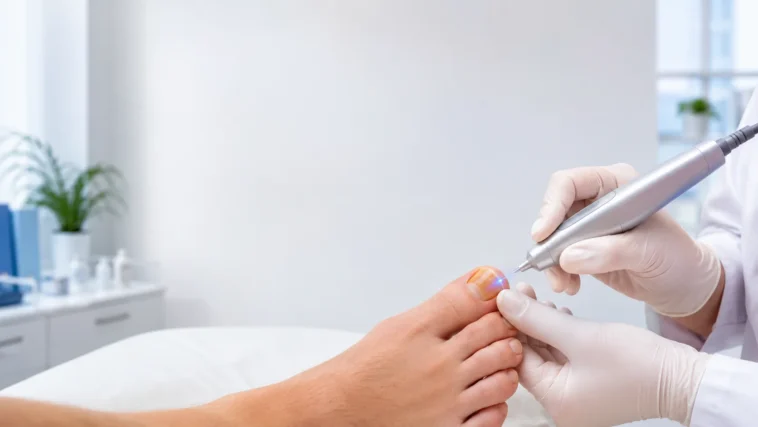
Laser treatment for nail fungus has become one of the most talked-about options for people who are tired of dealing with thick, yellow, or brittle nails. Many clinics advertise laser therapy as a quick solution, but does it really cure nail fungus?
The answer is a little more complicated than a simple yes or no. Current research suggests that laser treatment can help improve the appearance of infected nails and may reduce fungal growth. However, medical experts still consider oral antifungal medications the most reliable treatment for many patients, especially those with moderate to severe infections. Laser therapy is often used as an additional treatment rather than a complete replacement.
If you’re considering laser treatment, here’s what you should know before booking an appointment.
Key Takeaways
- Laser treatment is a non-invasive option for nail fungus.
- Most people need multiple treatment sessions.
- Healthy nail growth takes several months.
- Laser therapy may work best when combined with antifungal medication.
- Results vary from person to person.
- Good foot hygiene is essential to prevent the infection from returning.
What Is Laser Treatment for Nail Fungus?
Laser treatment uses concentrated light energy to target the fungus living under the nail. The heat produced by the laser is designed to damage fungal cells while causing little or no harm to the surrounding healthy tissue.
Unlike oral medications, laser therapy doesn’t require taking pills every day, and there is usually no recovery time after the procedure. Most appointments last between 20 and 30 minutes, depending on the number of nails being treated.
How Does Laser Therapy Work?
The laser passes through the nail plate and delivers heat to the infected area beneath the nail. This heat may weaken or destroy fungal organisms, allowing healthy nail tissue to grow over time.
Because nails grow very slowly, laser treatment does not produce immediate results. Even if the fungus is successfully reduced, the damaged nail must grow out before you notice a significant improvement.
Is Laser Treatment Effective?
Research on laser therapy has shown encouraging results, but the evidence is still limited.
Some clinical studies have reported healthier nail growth and reduced fungal infection after laser treatments. However, larger medical reviews continue to state that more high-quality research is needed before laser therapy can be considered a standard treatment for onychomycosis.
Many dermatologists recommend laser treatment alongside topical or oral antifungal medications rather than using it alone.
What Do Dermatologists Recommend?
Most skin specialists agree that laser treatment can be helpful for some patients, but it should not be viewed as a guaranteed cure.
Oral antifungal medicines remain the first choice for many people because they have the strongest scientific evidence for eliminating fungal infections. Laser therapy may be recommended if someone cannot safely take oral medication because of liver disease, medication interactions, or other health concerns.
Your dermatologist will usually examine the nail and may even test a nail sample before recommending the best treatment.
Benefits of Laser Treatment
There are several reasons why laser therapy has become popular.
Non-Invasive
No surgery is required, and the nail usually does not need to be removed.
Minimal Downtime
Most people can return to work or daily activities immediately after the appointment.
No Daily Medication
Laser therapy eliminates the need to remember daily pills or apply medication several times each day.
Low Risk of Serious Side Effects
Because the treatment targets only the affected area, serious side effects are uncommon when performed by an experienced professional.
Potential Drawbacks
Although laser treatment offers several advantages, it also has some limitations.
- Multiple treatment sessions are usually needed.
- Results are not guaranteed.
- Improvement can take several months.
- The treatment can be expensive.
- Many insurance companies do not cover the procedure.
Who Is a Good Candidate?
Laser treatment may be a good option if you:
- Have mild or moderate nail fungus.
- Cannot take oral antifungal medication.
- Prefer a non-drug treatment.
- Want to combine laser therapy with other treatments.
People with severe infections involving most of the nail often benefit from combining laser therapy with prescription antifungal medication.
What Happens During the Procedure?
The procedure is usually simple and comfortable.
First, the nail is cleaned and trimmed. In some cases, thick nails are filed down to allow the laser to reach the infected area more effectively.
The doctor then moves the laser across the infected nail for several minutes. Most patients describe the sensation as mild warmth or tiny pinching feelings that disappear quickly.
Once the treatment is finished, you can immediately return to your normal routine.
How Many Sessions Will You Need?
There isn’t one schedule that works for everyone.
Many clinics recommend between three and six treatment sessions spaced several weeks apart. People with more severe fungal infections may need additional treatments.
Your dermatologist will create a treatment plan based on the severity of the infection and how well your nail responds.
How Long Does It Take to See Results?
Laser treatment does not instantly create a healthy nail.
Instead, healthy nail slowly replaces the damaged portion as it grows.
Most people notice early improvement within two to four months.
Clearer nail growth often becomes visible after six to nine months.
Toenails usually require nine to eighteen months to completely grow out because they grow much more slowly than fingernails.
Does Laser Treatment Hurt?
Most patients report very little discomfort.
You may feel warmth, tingling, or small snapping sensations during the procedure, but these feelings usually disappear within seconds.
No anesthesia is required for most treatments.
Can Nail Fungus Come Back?
Yes.
Even after successful treatment, fungal infections can return if preventive care is ignored.
You can reduce your risk by:
- Keeping your feet clean and dry.
- Changing socks every day.
- Wearing breathable shoes.
- Disinfecting nail clippers regularly.
- Avoiding walking barefoot in public showers, gyms, and swimming pool areas.
- Treating athlete’s foot promptly if it develops.
Pros
- Non-invasive procedure
- No recovery time
- Minimal discomfort
- No daily medication
- Can be combined with other treatments
- Suitable for some patients who cannot take oral medication
Cons
- Can be expensive
- Usually requires multiple sessions
- Results vary from person to person
- Improvement is slow
- Infection may return over time
- Often not covered by insurance
Frequently Asked Questions
Is laser treatment a permanent cure for nail fungus?
Not always. Some people experience long-term improvement, but recurrence is still possible.
Is laser treatment better than antifungal pills?
For many patients, oral antifungal medication remains the most effective treatment. Laser therapy may provide additional benefits when combined with medication or when pills are not suitable.
Is the procedure painful?
Most people experience only mild warmth or slight discomfort during treatment.
How long does one session take?
A typical session lasts around 20 to 30 minutes, depending on how many nails are treated.
How soon will my nail look normal?
Healthy nail growth usually becomes noticeable after several months, while a toenail may take up to 18 months to completely replace the damaged nail.
Final Thoughts
Laser treatment for nail fungus offers a modern, non-invasive option for people looking to improve infected nails. While many patients see healthier nail growth and cosmetic improvement, current medical evidence suggests that laser therapy works best as part of a complete treatment plan rather than as a guaranteed standalone cure.
If you suspect you have nail fungus, schedule an evaluation with a dermatologist or podiatrist before starting treatment. An accurate diagnosis, combined with the right therapy and good foot care habits, gives you the best chance of growing healthy, clear nails again.
GIPHY App Key not set. Please check settings